%20(1).avif)


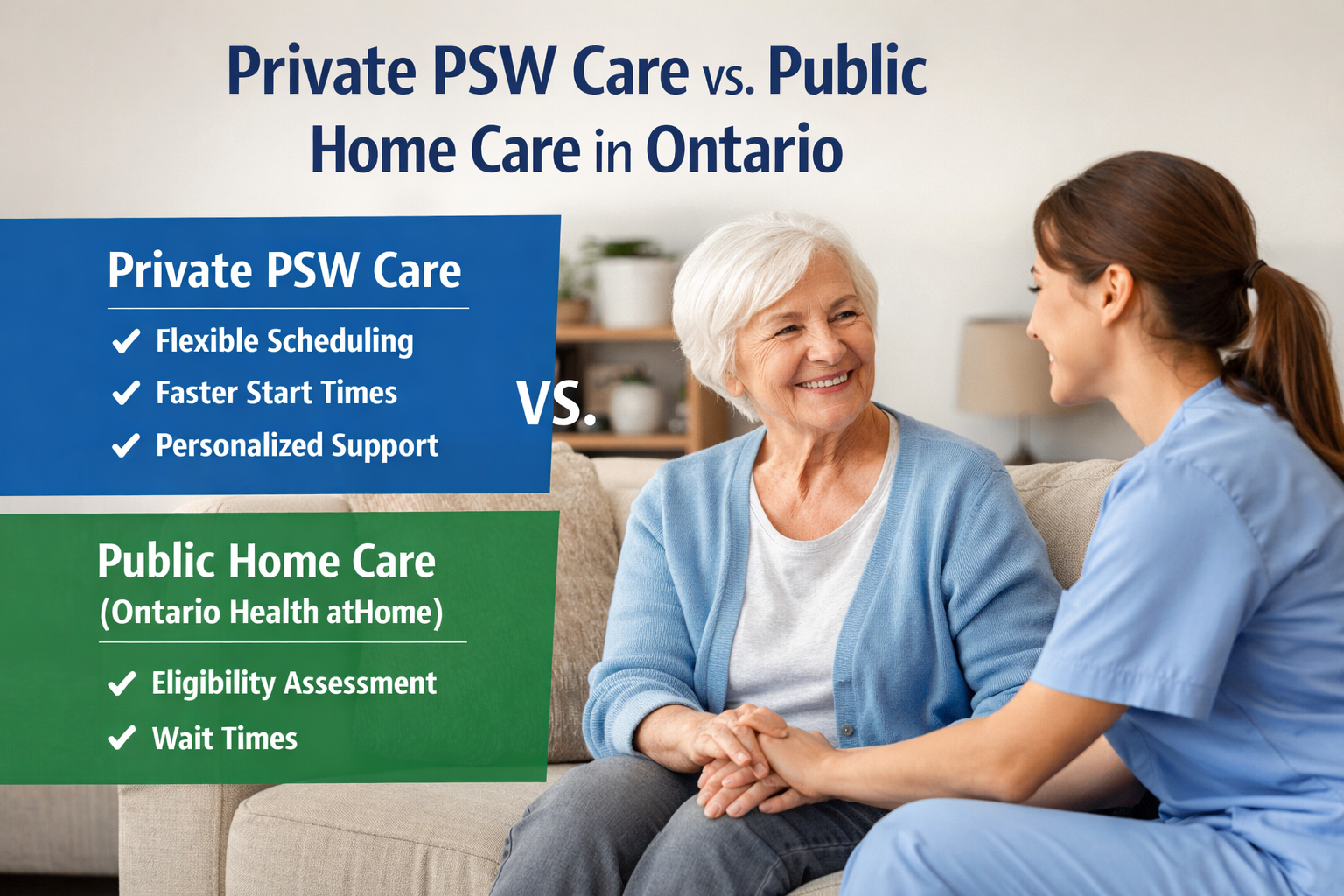
Private PSW Care vs. Public Home Care in Ontario: What’s the Difference?
If you’re exploring help at home for yourself or a loved one, you’ll usually come across two paths:
- Publicly funded home care, coordinated through Ontario Health atHome
- Private PSW (Personal Support Worker) care, arranged directly with a provider like HealthCasa
Both can be helpful. The right choice depends on your needs, timing, and how much flexibility you want.
What does a PSW do?
A Personal Support Worker (PSW) helps with hands-on, day-to-day support that can make home life safer and more comfortable, such as:
- Personal care support (bathing, dressing, grooming)
- Mobility assistance and transfers
- Meal support and feeding assistance
- Light housekeeping and companionship
- Respite support for family caregivers
At HealthCasa, all caregivers are PSWs, fully certified, and complete thorough background checks.
Option 1: Publicly funded home care in Ontario
In Ontario, publicly funded home and community care is coordinated through Ontario Health atHome. It can help you access home care, connect to community supports, and it also supports long-term care placement services.
How public care typically works
When you contact Ontario Health atHome, a care coordinator can:
- Complete an assessment to help determine eligibility
- Develop a care plan if you’re eligible
- Provide information and guide you through options
Where to start: Ontario Health atHome’s main phone line is 310-2222 (no area code required).
A practical consideration: wait times can happen
Public services are based on eligibility and availability. Wait times vary, and multiple organizations track and define “wait time for home care services” (for example, as the median days waited for a first home care service).
Publicly funded care can be an excellent support, especially when you qualify and services are available - but families sometimes need additional help at specific times of day, or sooner than the public system can provide.
Option 2: Private PSW care
Private PSW care is arranged directly by you (or your family), outside the publicly funded system.
Families often choose private PSW care when they want:
- Faster start times
- More flexibility (mornings, evenings, weekends)
- More hours than what’s available publicly
- Continuity and caregiver fit (more consistency, preference-based matching)
- Respite that’s scheduled around family caregivers’ real lives
At HealthCasa, private PSW support is designed to be straightforward to start — and built around matching clients with experienced, compassionate PSWs.
Private vs. public: a simple comparison
Public home care (Ontario Health atHome)
Best for:
- People who may qualify through a public assessment
- Families comfortable with system-led scheduling and availability
What to expect:
- Eligibility assessment and care planning coordinated through Ontario Health atHome
- Service levels and timing can depend on availability; wait times are tracked as a system measure
Private PSW care
Best for:
- People who want help on their timeline
- Families looking for flexible schedules and additional hours
- Anyone who wants to add support beyond what’s available publicly
What to expect:
- You choose the schedule and level of support
- Easier to add targeted coverage (e.g., mornings, evenings, respite blocks)
- A more customized approach based on needs and preferences
Many families use both: “public care + private top-up”
A common approach is combining:
- Publicly funded services (when eligible/available), and
- Private PSW support to fill gaps (extra hours, specific routines, respite, or faster start)
Ontario.ca explicitly notes Ontario Health atHome can provide referrals and information to other providers as part of navigating home and community care.
What HealthCasa private PSW care includes
HealthCasa provides private in-home PSW services with a focus on trust, safety, and compassionate support.
With HealthCasa, you can expect:
- Certified PSWs
- Thorough background checks
- Care matched to needs, preferences, and goals
Frequently Asked Questions (FAQ)
1) Can I receive public home care and private PSW care at the same time?
Yes. Many families use private care to supplement publicly funded services — especially for extra hours, specific times of day, or respite.
2) How do I access publicly funded home care in Ontario?
You can start by contacting Ontario Health atHome, where a care coordinator can assess needs, determine eligibility, and guide options.
Ontario Health atHome’s main line is 310-2222.
3) Does public home care cover everything I need?
It depends on eligibility and availability. Public care is often a strong foundation, but some people need additional support hours or more precise scheduling than the public system can offer.
4) Is private PSW care “better” than public care?
Not necessarily — it’s different. Public care can be a great option when you qualify and services are available. Private care is often chosen for flexibility, speed, and customization.
5) What kinds of help can a private PSW provide?
Common support includes personal care (bathing/dressing), mobility support and transfers, meal support, companionship, light housekeeping, and respite for caregivers.
6) How quickly can private care start?
Often faster than public options, depending on your preferred schedule and availability. A short intake call is usually the first step.
7) Will I get the same PSW each visit?
Private care generally makes it easier to aim for consistency. Continuity depends on scheduling needs and availability, but it’s a common goal for private matching.
8) Is private PSW care available evenings, weekends, or overnight?
Private care is typically more flexible for non-standard times. Availability depends on your area and staffing.
9) How do I know a PSW is qualified and trustworthy?
Ask about certification, screening, and matching. HealthCasa notes its PSWs are fully certified and undergo thorough background checks.
10) What should I prepare for an intake call?
Helpful details include:
- The kind of help needed (personal care, mobility, meals, respite)
- Preferred schedule and start date
- Safety considerations (stairs, walker/wheelchair, bathing setup)
- Goals (independence, routine support, caregiver relief)
11) What if needs change over time?
Care plans can typically be adjusted - more support after a hospital stay, then reduced later, or increased gradually as needs evolve.
12) Does Ontario track wait times for home care?
Yes — there are indicators that define and track wait times, such as the median number of days clients wait for their first home care service.